I Stopped Forgetting DSA Problems After Building My Own Notion Dashboard
I solved hundreds of DSA problems, but I kept forgetting the same patterns in interviews. So I built a Notion dashboard that tells me exactly what to practice, when to revise, and what I'm still weak at. This is the system that made DSA feel sustainable instead of overwhelming.
What you'll learn
- 01Solving more DSA problems doesn't guarantee better interview performance—retaining patterns does.
- 02Most popular question sheets are great checklists but poor revision systems.
- 03My Notion dashboard transforms every solved problem into a living record with spaced revision.
- 04Tracking confidence is more valuable than tracking completion.
- 05Daily queues eliminate decision fatigue and make consistency much easier.
- 06Missed revisions become manageable instead of overwhelming.
- 07Over time, the dashboard becomes less like a tracker and more like an operating system for DSA preparation.
#I Stopped Forgetting DSA Problems After Building My Own Notion Dashboard
If you've been preparing for coding interviews for even a few weeks, you've probably experienced this.
You solve a Linked List problem on Monday.
By Thursday, you vaguely remember the approach.
Two weeks later, you see the same pattern again... and it's almost like you're solving it for the first time.
That used to happen to me constantly.
I wasn't struggling because DSA was difficult.
I was struggling because I had no system.
Like most people, I downloaded every famous sheet I could find.
- Striver A2Z
- Blind 75
- NeetCode
- LeetCode Top Interview Questions
- Company-wise sheets
I kept checking boxes.
The number of solved questions kept increasing.
But my confidence never did.
Because every week I realized something frustrating:
I wasn't learning new patterns anymore. I was relearning old ones.
That's when I realized the biggest problem with most DSA preparation.
It isn't solving.
It's remembering.
#The Problem Nobody Talks About
Most DSA advice on the internet looks something like this.
Solve 150 Questions.
Complete This Sheet.
Finish These 200 Problems.
It sounds motivating.
Until you actually finish them.
Then a month later someone asks you to solve one of those problems again...
...and you can't remember the optimal approach.
That's because almost every popular sheet is designed as a checklist.
Not as a learning system.
A checklist tells you
"Solve this."
A learning system tells you
"When should you see this again?"
Those are completely different things.
#So I Built My Own System
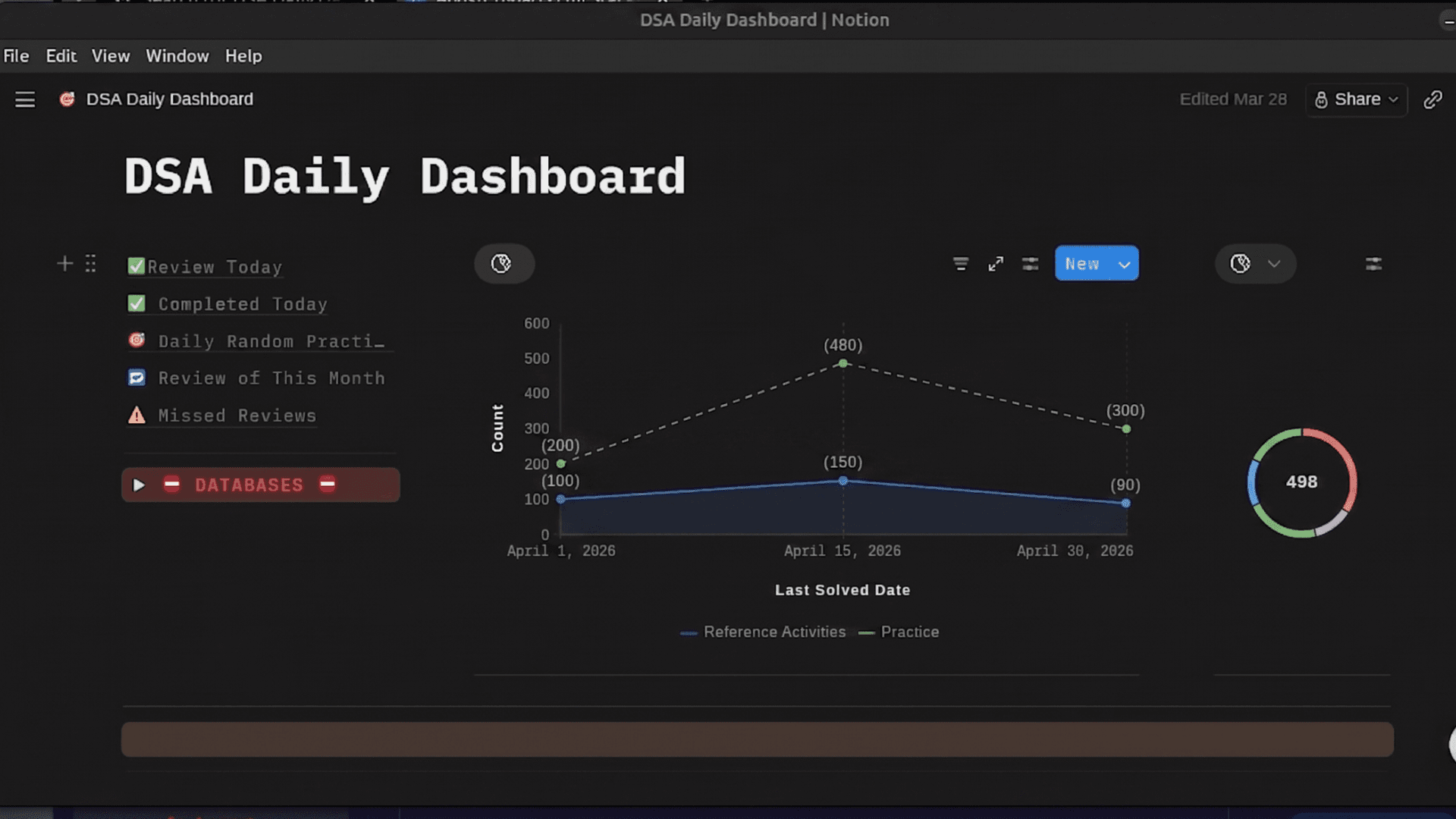
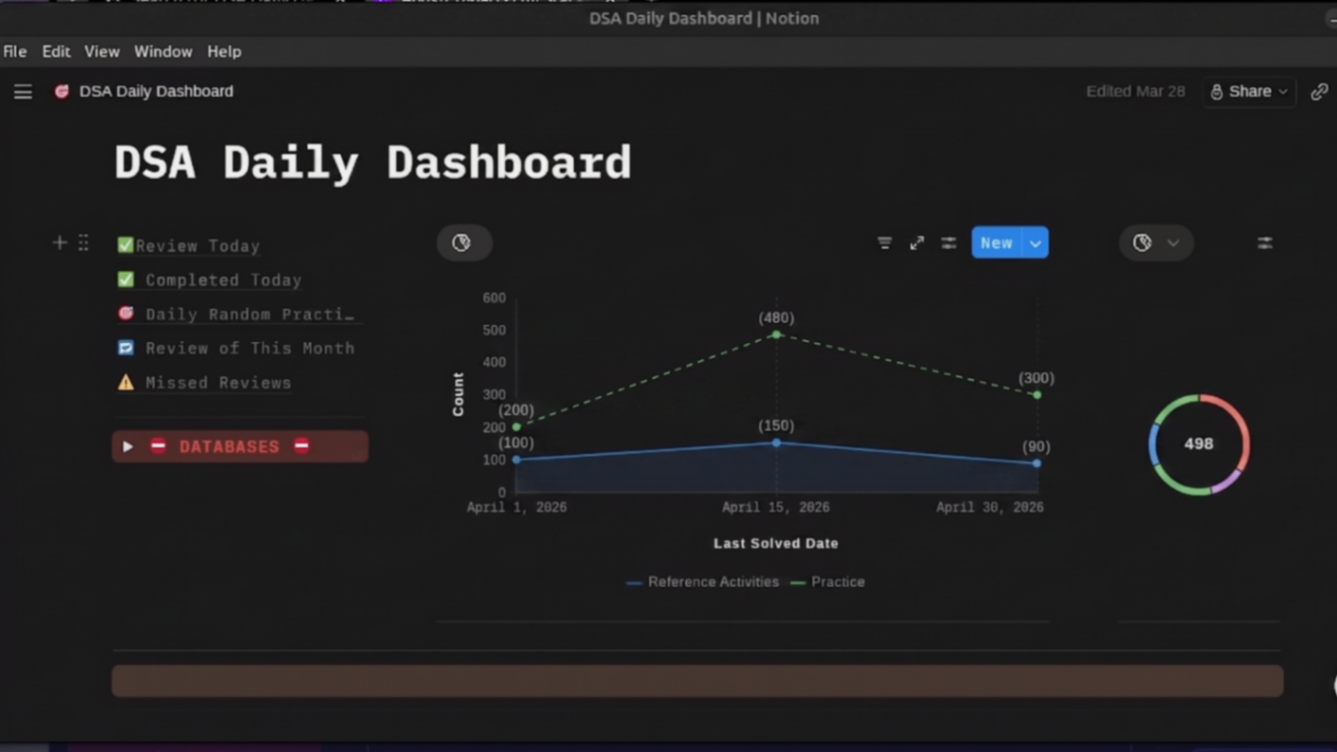
Instead of maintaining another Excel sheet full of green checkmarks, I built a complete DSA Dashboard in Notion.
Not because Notion is magical.
But because I wanted one place that answered every question I had while preparing.
Questions like
- What should I solve today?
- Which problems am I forgetting?
- Which topics are actually weak?
- Which concepts need revision?
- Which questions have I truly mastered?
- Which problems did I solve only because I saw the solution yesterday?
The dashboard answers all of those automatically.
Instead of tracking completion...
It tracks learning.
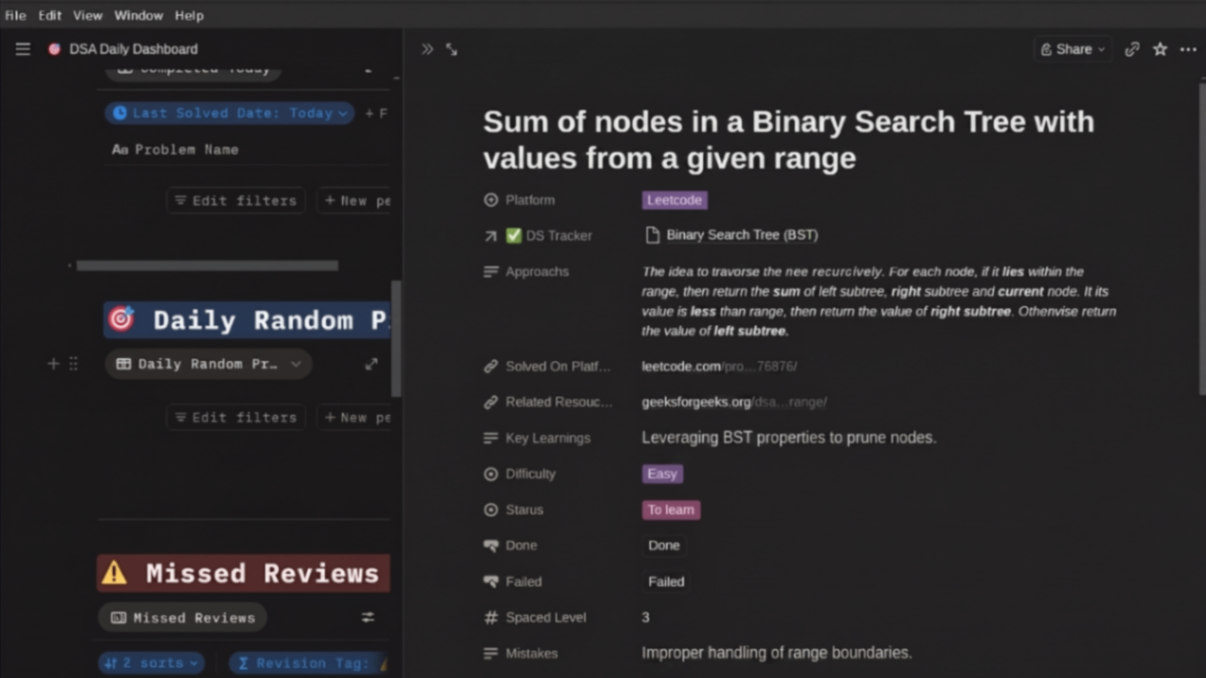
#Every Problem Becomes a Living Record
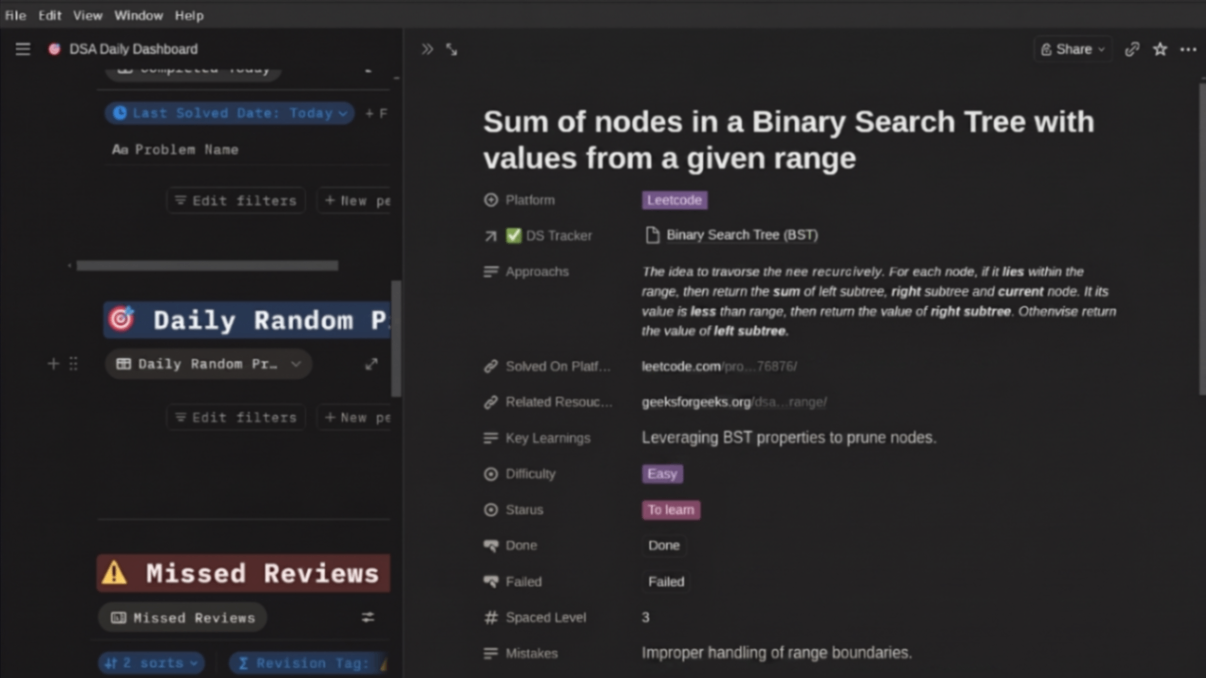
Whenever I solve a problem, I don't just paste the link and move on.
I record things that actually matter.
- Platform
- Difficulty
- Topic
- Confidence level
- Whether I solved it without hints
- Mistakes I made
- Key learning
- Better approaches
- Pattern used
- Last solved date
Then the dashboard takes over.
It automatically decides
- when I should review it again,
- whether it's overdue,
- whether it's becoming stronger,
- or whether I still don't really understand it.
After a while, I stopped depending on memory.
The system remembers everything for me.
#My Daily DSA Routine Is Surprisingly Simple
One of the biggest benefits is removing decision fatigue.
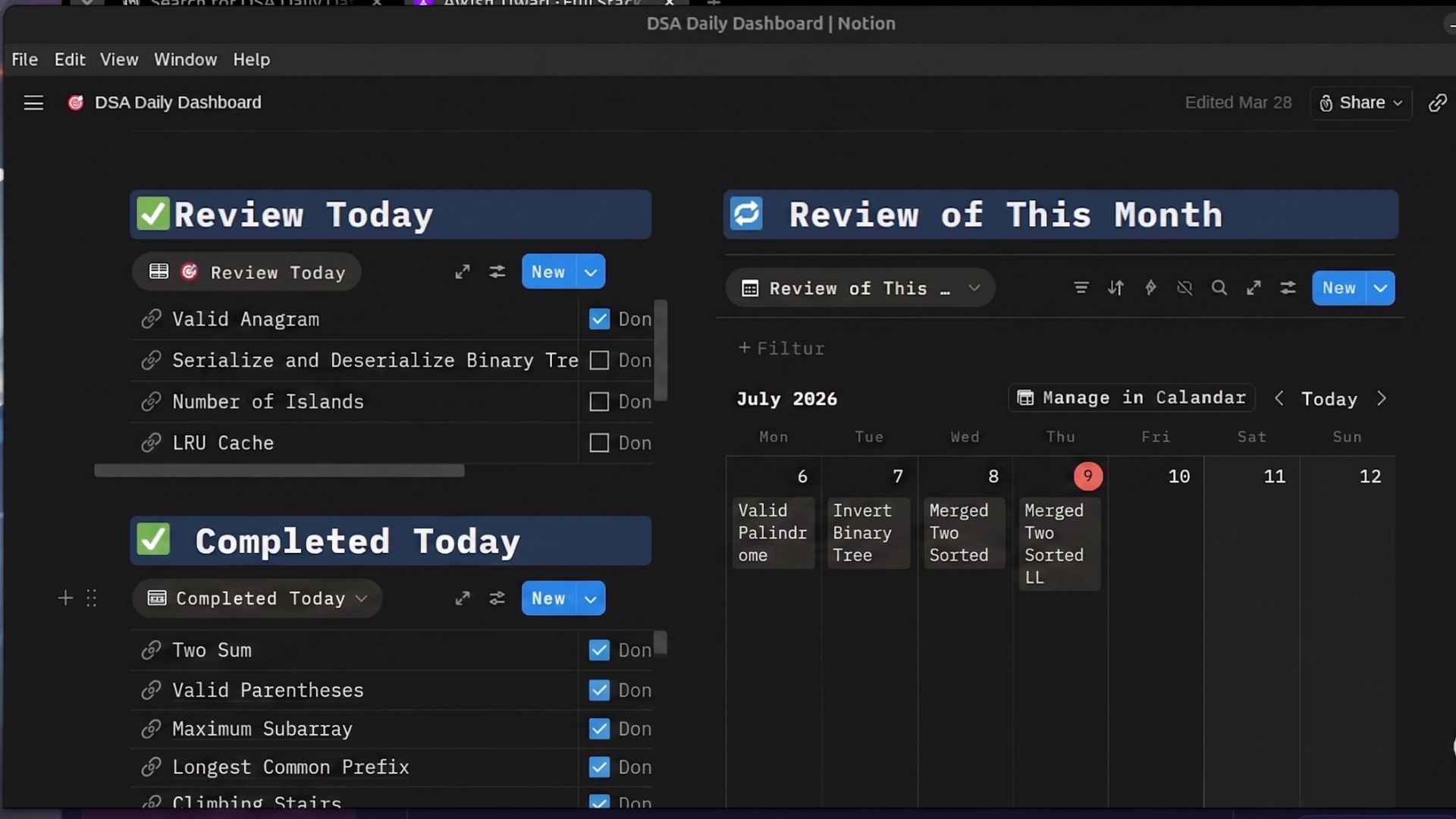
Every morning I open one page.
That's it.
I don't waste 20 minutes deciding what to practice.
The dashboard already knows.
A normal day looks like this.
#Step 1
Solve one or two new problems.
#Step 2
Write what actually mattered.
Not the whole solution.
Just
- mistakes
- observations
- patterns
- tricky edge cases
#Step 3
Rate my confidence honestly.
Not
"I understood while watching the solution."
But
"Could I solve this tomorrow without help?"
There's a huge difference.
#Step 4
The dashboard schedules the next revision.
No manual planning.
No reminders.
No calendar.
Everything happens automatically.
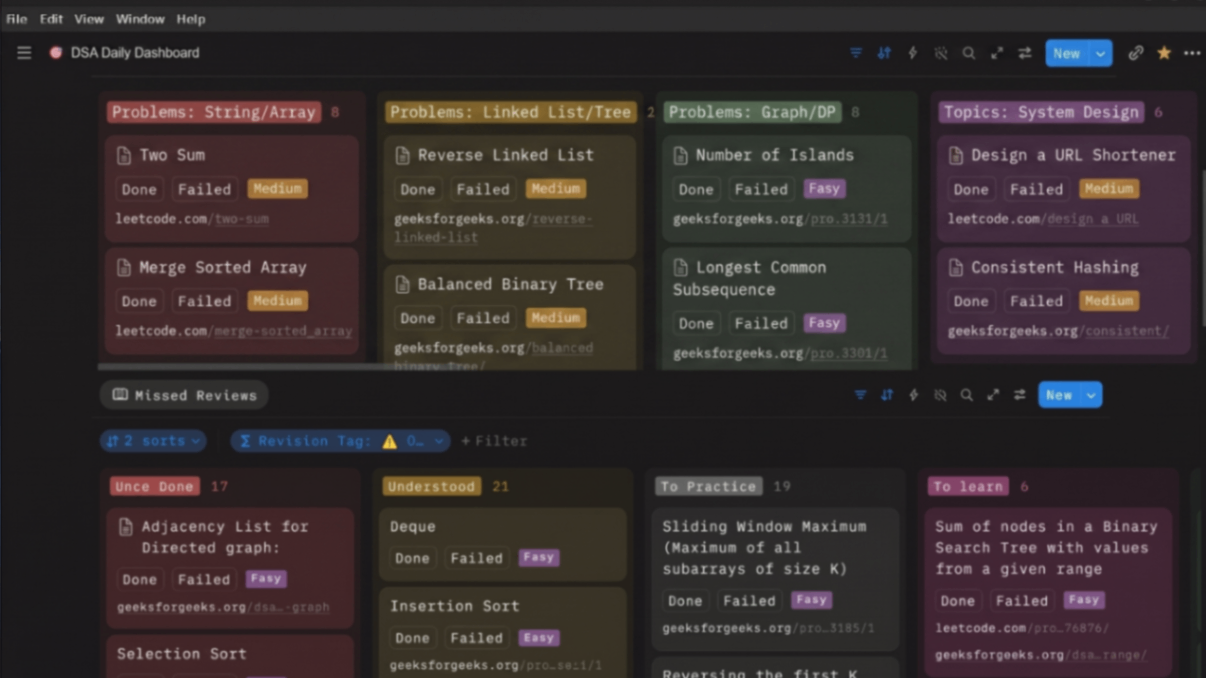
#What Happens If I Forget?
This is my favorite feature.
Nothing breaks.
If I miss a revision, the problem doesn't disappear forever.
It simply moves into a Missed Reviews queue.
No guilt.
No panic.
Just another chance to strengthen that pattern.
Instead of pretending I never missed it...
the dashboard simply adjusts.
That makes consistency much easier.
#Why I Track Confidence Instead of Just Completion
Most trackers only ask one question.
Did you solve it?
Mine asks another.
Could you solve it again?
That's the only metric interviews actually care about.
Nobody gives extra marks because you solved a question three months ago.
They care whether you can recognize the pattern today.
That's why confidence matters much more than completion.
#My Dashboard Isn't Just One Table
Over time it became an entire workflow.
It includes views like
- Review Today
- Completed Today
- Missed Reviews
- Monthly Revision Calendar
- Random Practice
- Theory Revision
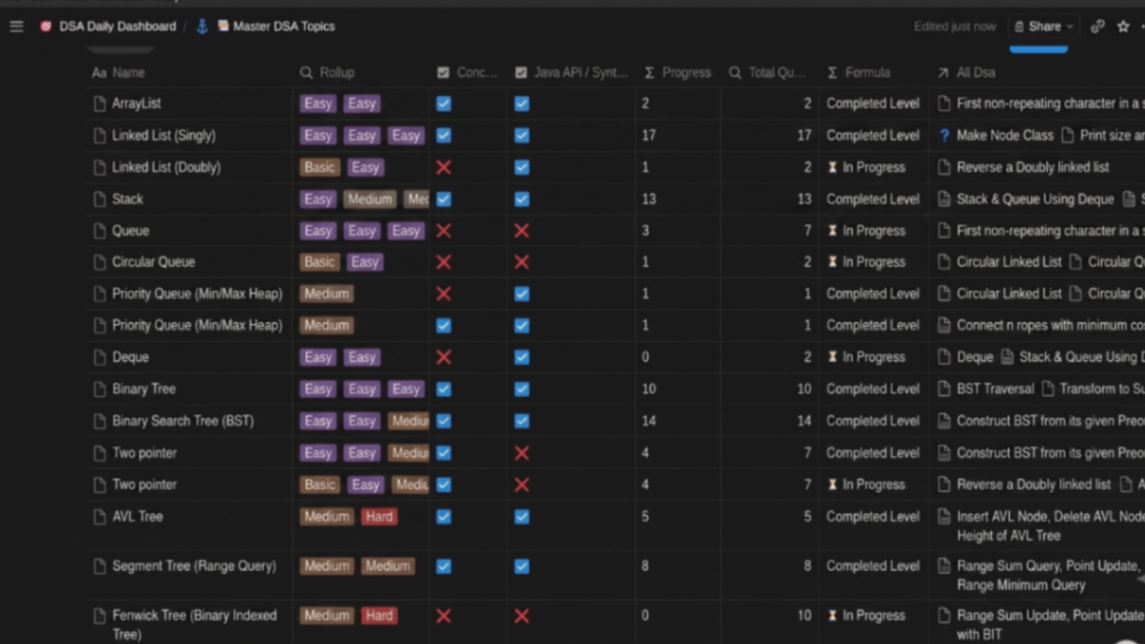
- Topic-wise Progress
- Difficulty Tracking
- Mastered Problems
Instead of scrolling through hundreds of rows...
I only see what deserves my attention today.
That's a much calmer way to prepare.
#It Even Shows My Progress Visually
Problem count isn't everything.
Sometimes I solve fewer questions because I'm spending more time revising.
And that's perfectly fine.
The dashboard helps me see things like
- weekly solved problems
- revision backlog
- topic coverage
- difficulty distribution
- mastery progression
- overdue reviews
Those charts remind me that improvement isn't always about solving more.
Sometimes improvement is simply forgetting less.
#A Typical Week Looks Like This
Monday
Solve one new Linked List problem.
Record mistakes.
Dashboard schedules the next review.
Tuesday
One new problem.
One revision from Monday.
Wednesday
Review older questions.
One feels easy.
Another feels shaky.
The shaky one comes back sooner.
Thursday
Solve another problem from the same pattern family.
Now pattern recognition starts happening naturally.
Friday
Mostly revision.
No pressure to solve ten new problems.
Just strengthening what I already know.
Weekend
Catch up on missed reviews.
No guilt.
No giant backlog.
Just a clean reset before the next week.
#The Biggest Lesson I Learned
I used to believe that better DSA meant solving more questions.
Now I think better DSA means forgetting fewer questions.
Those are completely different goals.
One chases numbers.
The other builds long-term memory.
And interviews reward memory far more than statistics.
#Want the Dashboard?
I've decided to share this Notion template with the community.
If you'd like a copy,
share this blog on LinkedIn, tag me, and send me a message.
I'll personally send you the Notion template.
Hopefully it saves you from making the same mistake I made solving hundreds of questions only to forget them a few weeks later.
Because DSA isn't a race to finish a sheet.
It's a process of building patterns that stay with you.
And having the right system makes all the difference.
Key Takeaways
- ✓Solving more DSA problems doesn't guarantee better interview performance—retaining patterns does.
- ✓Most popular question sheets are great checklists but poor revision systems.
- ✓My Notion dashboard transforms every solved problem into a living record with spaced revision.
- ✓Tracking confidence is more valuable than tracking completion.
- ✓Daily queues eliminate decision fatigue and make consistency much easier.
- ✓Missed revisions become manageable instead of overwhelming.
- ✓Over time, the dashboard becomes less like a tracker and more like an operating system for DSA preparation.